
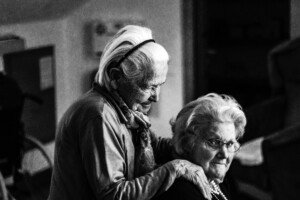
So much of care work is unpaid, and is carried out by partners or other family members. The carers of people living with dementia or neurodegenerative diseases are usually past retirement age and may have health issues themselves. Carers are often faced with multiple challenges including fatigue, financial and time constraints, and social isolation. Their own wellbeing can easily become overshadowed by the demands of their caring.
Where caregiver support is available, it tends to focus on respite care, relaxation methods, or simply providing information. A new study published in the International Journal of Geriatric Psychiatry explored a different approach to supporting carers, one using a group-based programme in the Alexander Technique. The programme was developed by the US-based Poise project and used a standardised content and format to teach the essential skills of the Alexander Technique.
The study involved 63 people who were all caring for someone living with Parkinson’s. They attended weekly Alexander-based group sessions over ten weeks, with follow-up six months later.
The study demonstrated that the Alexander programme was both feasible to deliver and rated highly by the participants. Most of the participants (84%) stayed to the end of the course and attendance at classes was high (85%). Participants consistently valued not only the Alexander work itself but also the opportunity to learn alongside others facing similar challenges. Determining the feasibility and the acceptability of the course was the main aim of the study and the findings have, therefore, done the necessary groundwork for a future randomised controlled trial to determine the effectiveness of this intervention.
The study also evaluated a range of outcome measures. Because this was a small study without a control group, the outcomes reported should be regarded as preliminary but they are, nonetheless, encouraging. The participants showed improvements in their executive function (inhibitory control and working memory) and the improvement was found to be sustained at the 6 month follow-up. The authors point out that ‘this enhancement in cognitive control following a course employing embodied learning is consistent with literature suggesting that a more accurate body schema and increased executive attention to movement may foster skills that transfer to decisions and actions in daily life’.
Other benefits observed included sustained improvements in three different measures of emotional self-regulation. These changes may potentially have come about because learning the Alexander Technique developed skills for managing the physical and emotional challenges of caregiving, and reduced stress through less muscular tension and interference with breathing. In addition, the core Alexander skill of not automatically immediately reacting to stimuli (instead bringing awareness back to oneself and surroundings), allows time for conscious choice. Thus carers can learn to pause before responding to a care recipient’s needs, and this can enable more agency and usually a more appropriate response.
The study also evaluated participants’ balance and mobility and these had also significantly improved when assessed at both the course and at 6 months’ follow-up. These results are in line with other research that has shown Alexander instruction to lead to improved balance, movement and postural support.
Of course, some of these benefits may have derived from factors unrelated to learning the Alexander Technique, such as being in a supportive social environment. However, because the improvements were still present six months after the course had ended, this suggests that participants had continued to apply what they had learned in their Alexander classes to their everyday life.
The group-based format had several advantages over one-to-one tuition. Caregiving can be profoundly isolating. Spending time with people who understand the emotional complexity of the role can be extremely valuable and participants can learn from one another as well as from the teacher. Another benefit is that it is usually more cost effective to run a class for a group than for an individual, enabling greater accessibility. A distinctive feature of this study was that an onsite Alexander‐based respite class was provided for care receivers. This proved to eliminate the barrier caused by reluctance of carers to leave their partner with a stand-in carer at home. In addition, there was the added value of both partners receiving Alexander instruction.
This is not the first research that has been done about carers who learnt the Alexander Technique. In a 2022 analysis of survey data, reported benefits for carers of having Alexander lessons included improvements in confidence, resilience, mood, motivation and physical comfort, as well as reductions in pain and levels of anxiety. In addition, a small pilot study showed that carers of people living with dementia benefited from a one-off session on the Alexander Technique. They found that applying the Alexander Technique was calming and they recognised it as something that could fit in with their everyday life.
The Alexander Technique is essentially a self-care method. Knowing how to look after yourself and being able to put this into practice, even in stressful situations, is key to sustaining a role as a carer.
You can read the publication abstract here.
Reference
Cohen RG, Bellingham JG, Mello B, Bond L, Gross M. ‘Partnering with Poise’: A preliminary study of an Alexander Technique-based group course for informal care partners. International Journal of Geriatric Psychiatry 2026;41(7):e70233. doi: 10.1002/gps.70233.