
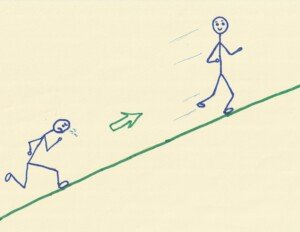
It’s now 3 years since I took up running, prompted by discovering that I was heading towards osteoporosis. Thanks to Couch to 5K for getting me started and to the Alexander Technique for keeping me going. I’m still running three times a week, mostly 30 minute runs and sometimes up to an hour. I think that’s not bad for me, the unlikeliest of runners! I figure it’s pretty good for my bones and it’s certainly been great to stay reasonably fit, particularly as I’m getting older. There’s no sign of me getting much faster but that’s ok with me.
As part of one of my regular routes, there are quite a few small hills to negotiate. It’s struck me how different my approach is now with the Alexander Technique, to how it would have been if I’d never come across this amazing self-help method.
Firstly, what I don’t do as I approach the hill – I don’t steel myself to get ready and try harder, nor do I think ahead to how hard it’s going to be, nor grit my teeth, and I don’t then just plough on determinedly, pushing harder with my legs.
So what do I do? Well, I remind myself that I don’t need to do or think any of those things. Instead I pay attention to what’s happening with myself right now, rather than thinking ahead. My aim is to look after myself as best I can – staying expansive and buoyant, rather than constricting with effort. This aim is more important to me than the goal of getting to the top. Indeed, with any goal, large or small, I don’t go for it at any cost but instead pay more attention to the best way of achieving the goal. As I’m going up the hill, I’m staying in the present, thinking my Alexander directions.
If you get the chance to watch people running, you can often tell which direction they’re thinking in i.e. where their attention is, and this is usually down towards the ground. Now, because the mind and body are not separate, whenever we place all our attention down in front of us, we will tend to lean in that direction also, either with the head or the whole torso. Without knowing it, we’ve then just set up ourselves up for everything being much harder work than it need be.
With the Alexander Technique we learn to think in the opposite direction – ‘up’. Applied to running up a hill I’m thinking in a ‘stay back and up’ direction from my tail out through the crown of my head, as well as up from the ground underneath my feet up through my torso and beyond. This is thinking not doing i.e. I’m not trying to alter or maintain a certain position or posture. Thinking is powerful and will always manifest physically in some way. For example, why do we end up hunched over our phone or laptop? It’s because all our attention is absorbed in that direction, so the rest of us wants to follow. The more that we can keep our awareness of ourselves and our surroundings three-dimensional, and to positively counteract our habitual tendency to ‘think down’, the more we will stay upright and springy.
Of course, I’m not claiming that it doesn’t take more effort to go up a hill than running on the flat – it does. However, what I’m interested in is all the unnecessary extra effort that we tend to make because of our habitual approach to challenges – we tend to just try harder. But if the extra work we’re putting in isn’t well coordinated, then it’s wasted.
If you have some experience of working with the Alexander Technique, this will all make sense to you; if not, it might sound a little perplexing. This is where Alexander lessons come in – we need actual practical experience, guided by a facilitator, an Alexander teacher.
You might wonder why I’m telling you all this if you can’t just go out there and do it for yourself? Well, I guess I’m trying to entice you to take that first step and book an introductory lesson. You can find a directory of UK registered teachers here, or, if you’re based in or around Edinburgh, you’re welcome to get in touch. In the meantime, if you just want to dip your toe in, why not try the Alexander lying down practice?
And, oh yes you’re right, the title of this post is also a reference to the wonderful music of Kate Bush.